
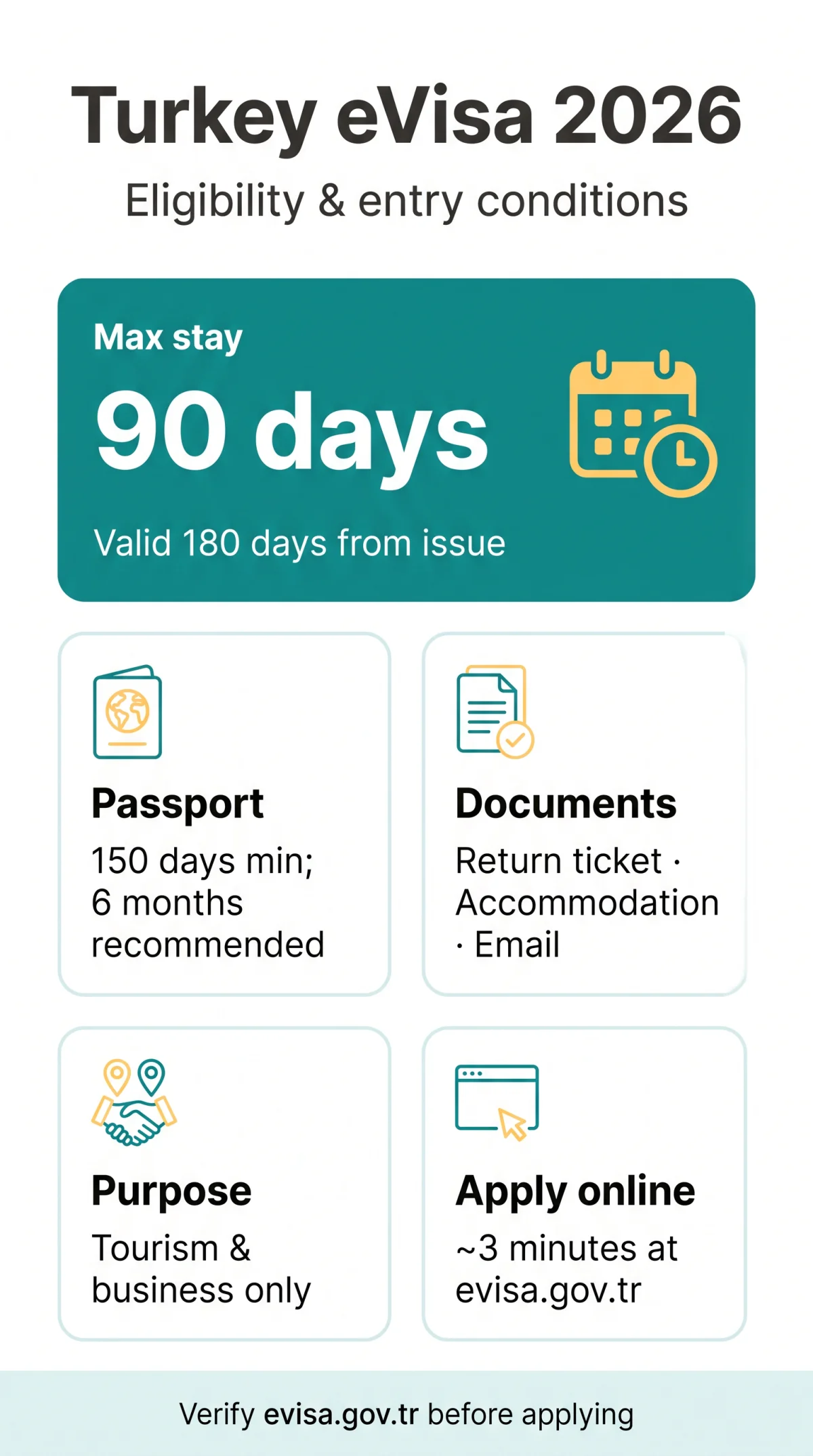
eVisa Turkey requirements in 2026 include a valid passport with at least 6 months’ validity, a completed online application, proof of return travel, confirmed accommodation, and payment of the eVisa fee. Eligible citizens from over 90 countries can apply online, while certain nationalities are ineligible and must obtain a traditional visa. The eVisa is valid for 180 days with a maximum stay of 90 days, and it permits tourism and business activities only.
Last updated: March 2026. This guide is independently researched and not affiliated with any government agency. For official confirmation, always refer to www.evisa.gov.tr. Rules may change; verify on the government portal before applying.
What Is the Turkey eVisa and Who Is It For?
The Turkey eVisa is a digital travel authorization launched in April 2013, replacing embassy visits for eligible nationalities entering Turkey for tourism or business.
This digital system specifically replaces traditional visa-on-arrival queues for English-speaking tourists and other eligible foreign nationals. It allows travelers to secure their entry document entirely online in approximately three minutes. To meet Turkey eVisa requirements, applicants must hold an eligible passport and intend to visit strictly for short-term purposes. The Turkey eVisa streamlines border control, ensuring visitors have pre-clearance before boarding their flights.
General Eligibility Rules for the Turkey eVisa
The Turkey eVisa requires a passport with at least 6 months’ validity, limits travel to tourism and business, and is available only by nationality.
According to the Republic of Türkiye Ministry of Foreign Affairs (www.mfa.gov.tr), the passport validity rule under Law No. 6458 Article 7 requires at least 60 days beyond the authorized stay. To satisfy Turkey eVisa requirements, mandatory conditions for all 2026 applicants include:
- Passport validity: 150 days minimum for a 90-day stay (90 days + 60 days buffer). However, airlines strongly recommend a 6-month buffer from arrival.
- Travel purpose: Restricted strictly to tourism and commerce.
- Documentation: Return ticket, accommodation proof, and sufficient funds.
UK Citizens and the Turkey eVisa
UK citizens holding British passports can enter Turkey visa-free for up to 90 days in any 180-day period for tourism or business without an eVisa.
Turkey eVisa requirements do not apply to British nationals holding ordinary passports. You bypass the digital application entirely. Your passport must simply be valid for at least 150 days when seeking entry at the border. For more details, see our complete eVisa Turkey guide for UK travellers.
List of Eligible Countries for Turkey eVisa in 2026
Citizens of over 90 countries are eligible for the Turkey eVisa, with single-entry or multiple-entry options depending on nationality.
Standard eligibility grants multiple entries, whereas conditional eligibility restricts the holder to a single entry. Conditional applicants must hold a valid Schengen, US, UK, or Ireland visa or residence permit to meet Turkey eVisa requirements. Additionally, as of 1 January 2026, Armenian official and diplomatic passport holders qualify for a 21-day Turkey eVisa.
Eligible Countries by Region
| Country Examples | Eligibility Type | Entry Type | Duration of Stay |
|---|---|---|---|
| Antigua and Barbuda, Bahamas, Barbados, Dominica, Mauritius, Mexico, Taiwan | Standard | Multiple entry | Up to 90 days |
| Afghanistan, Algeria (aged 15-18 & 35-50), Bangladesh | Conditional | Single entry | Up to 30 days |
Countries Ineligible for Turkey eVisa & Visa-Exempt Nations
Certain nationalities cannot apply for a Turkey eVisa and must obtain a traditional visa, while visa-exempt citizens (like UK and EU nationals) require no visa at all.
EU, EFTA and UK citizens – visa-free, up to 90 days/180 days. Travelers from ineligible nations do not meet Turkey eVisa requirements and must apply at a diplomatic mission. Understanding this distinction prevents unnecessary application fees for exempt tourists and boarding denials for ineligible ones seeking a Turkey eVisa.
| Country / Region | Reason | Alternative Visa Option |
|---|---|---|
| UK, EU (except Cyprus), EFTA | Visa-Exempt | No visa required |
| Cuba, North Korea, Syria | Ineligible | Traditional embassy visa |
Passport and Documentation Requirements for Turkey eVisa
The Turkey eVisa requires a passport valid for at least 6 months from entry, a return ticket, confirmed accommodation, and a valid email for delivery.

Airlines use the IATA Travel Centre database to verify requirements. Even if you meet the statutory Turkey eVisa requirements, your airline may deny boarding if your passport validity is under 6 months.
- Passport Validity Math: Legal minimum is 150 days for a 90-day stay.
- Blank Pages: At least one blank page for border stamps.
- Digital Delivery: Valid email address for the Turkey eVisa PDF.
- Data Accuracy: Must perfectly match passport details.
Entry Conditions for Turkey with an eVisa
Travelers must present a printed or digital eVisa, a matching passport, proof of accommodation, a return ticket, and evidence of sufficient funds at the border.
Documentation required at border in 2026 to satisfy Turkey eVisa requirements:
- Printed or digital Turkey eVisa.
- Matching passport.
- Return or onward ticket.
- Confirmed accommodation details.
- Proof of sufficient financial means.
Furthermore, Turkey eVisa requirements exempt passengers remaining entirely within the sterile transit area at Istanbul airports. Departing visitors exporting Turkish Lira worth more than 5000 US dollars must declare these funds.
Purpose of Visit: Tourism and Business
The Turkey eVisa permits tourism, sightseeing, business meetings, conferences, and medical treatment but strictly prohibits employment, study, and religious activities.
To comply with Turkey eVisa requirements, foreign nationals must adhere to permitted activities. Engaging in paid work on a tourist document is a severe violation of immigration law. If your trip involves academic enrollment or local employment, you cannot use the Turkey eVisa.
| Permitted Activities | Prohibited Activities |
|---|---|
| Tourism, sightseeing, holidays | Paid employment, local work |
| Business meetings, conferences | Academic study, university enrollment |
| Medical treatment | Religious missionary work |
eVisa Validity and Duration of Stay in 2026
The Turkey eVisa is valid for 180 days from the date of issue, allowing a maximum stay of 90 days within that validity period.
Standard: multiple entries; conditional: single entry. Turkey eVisa requirements dictate that visitors wishing to remain longer must extend their stay by applying for a short-term residence permit (ikamet) at a local police department before their current visa expires. Failing to secure this extension results in airport penalty fines and potential re-entry bans. Learn more about eVisa Turkey validity periods and extensions.
| Visa Type | Validity Period | Max Stay | Entries Allowed |
|---|---|---|---|
| Standard Turkey eVisa | 180 days | 90 days | Multiple |
| Conditional Turkey eVisa | 180 days | 30 days | Single |
How to Apply for a Turkey eVisa Online
Turkey eVisa applications are completed online in approximately 3 minutes by selecting nationality, entering passport details, and paying the fee by card.
Eligible travelers complete the process directly through the government portal at www.evisa.gov.tr. Fulfilling Turkey eVisa requirements involves three steps:
Select nationality & document type
Choose your nationality and travel document type
Enter travel dates & personal info
Enter details exactly as shown on your passport
Pay the required fee
Pay using an accepted credit or debit card
Typographical errors on an issued Turkey eVisa cannot be amended; applicants must submit a new application and pay the fee again. For a detailed walkthrough, see our step-by-step eVisa Turkey application guide.
eVisa Fees and Payment Methods
Turkey eVisa fees vary by nationality, are payable by credit or debit card, and are typically lower than airport visa-on-arrival fees.
The system processes transactions using Mastercard, Visa, and UnionPay. To meet Turkey eVisa requirements, the payment must clear before the document is emailed. Because fees are non-refundable, ensuring all data is correct before submitting your Turkey eVisa application is crucial. For a full breakdown, check our eVisa Turkey cost and fee guide.
Common Mistakes and Tips to Avoid eVisa Rejection
The most common Turkey eVisa rejection causes are incorrect passport details, insufficient passport validity, and applying through unofficial third-party websites.
Based on traveler feedback in 2025-2026, the most frequent mistake is entering a passport number with spaces. We recommend copying the passport number exactly as shown, including all characters, to avoid rejection. A real-world scenario: A traveler from Mexico with a standard Turkey eVisa was denied boarding because their passport had only 4 months of validity. Turkish authorities strictly enforce Turkey eVisa requirements of 150 days minimum.
Common border rejection causes:
- Mismatched passport details.
- Applying on scam websites.
- Mismatched travel dates.
- Lacking the 150-day passport validity.
FAQ: Frequently Asked Questions About Turkey eVisa Requirements
The Turkey eVisa FAQ covers eligibility by nationality, passport validity, fees, permitted activities, entry conditions, and the online application process.
Do UK citizens need an e-Visa for Turkey in 2026?
No, UK citizens holding ordinary British passports do not need a Turkey eVisa in 2026. They enjoy visa-free entry for tourism or business for up to 90 days within any 180-day period. Passports must be valid for 150 days.
What are the passport validity requirements for a Turkey eVisa?
By law, your passport must be valid for at least 60 days beyond your stay (150 days total for a 90-day stay). However, airlines strongly recommend 6 months of validity from arrival to meet Turkey eVisa requirements without boarding issues.
How long does it take to get a Turkish e-Visa?
The online application takes about 3 minutes. After paying the fee via debit or credit card, the approved Turkey eVisa is typically delivered to your email instantly.
What documents do I need for my Turkey e-Visa?
Turkey eVisa requirements mandate a valid passport with a blank page, a return ticket, confirmed accommodation, and proof of funds. You also need an email address and a payment card.
Can I work in Turkey with an eVisa?
No. The Turkey eVisa strictly permits tourism, business meetings, and medical treatment. Paid employment or academic study requires a traditional embassy visa.
What happens if I make a typo on my Turkey eVisa application?
Typos cannot be amended. If your Turkey eVisa data does not perfectly match your passport, you must submit a completely new application and pay the fee again.
How long is the Turkey eVisa valid for?
A standard Turkey eVisa is valid for 180 days, allowing a maximum stay of 90 days. Depending on your nationality, it grants either single or multiple entries.
Can I extend my stay in Turkey beyond 90 days?
Yes, you must extend your stay by applying for a short-term residence permit (ikamet) at a local police department before your Turkey eVisa expires to avoid penalties.